01
+
Visit MCX.center
Come in, explore the portfolio and spend time with the technology in Barsha Heights.

Forty years of obsessive AD/DA engineering — conversion and mic preamps trusted in the world’s finest rooms, from the interfaces behind countless hit records to the Symphony ecosystem. Symphony I/O Mk II anchors the studio; Duet 3, BOOM and Symphony Desktop bring the same converter lineage to the desk.
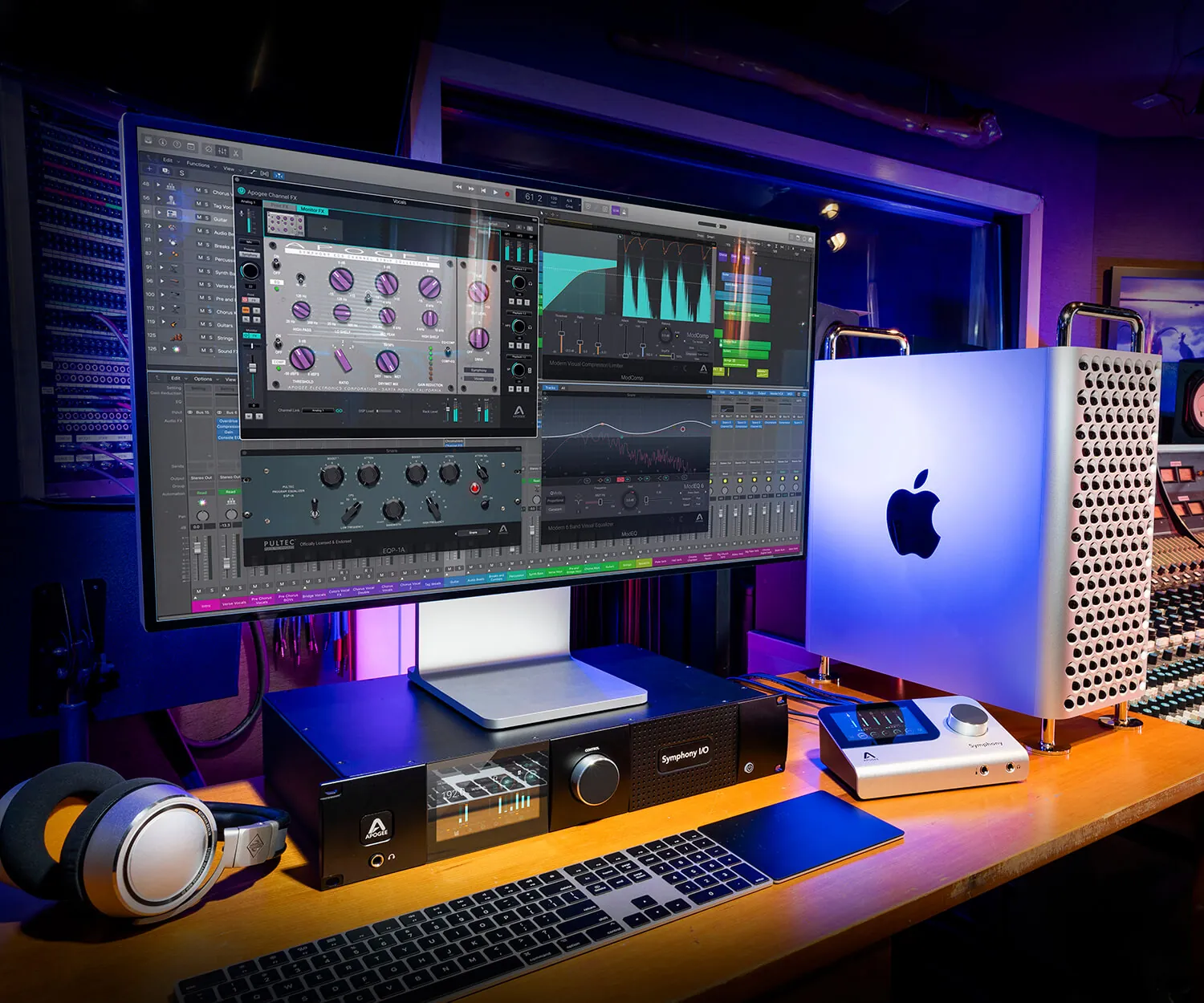
Betty Bennett founded Apogee Electronics in 1985 with a single mission: create the world’s most transparent digital-to-analogue conversion. The result was the original Apogee filter — a breakthrough that eliminated the harsh digital sound of early CD recordings and was immediately adopted by mastering facilities and major labels worldwide.
Today Apogee’s product range spans the professional Symphony I/O Mk II interface — the mastering-grade centerpiece of high-end studios globally — through to the Symphony Desktop, Duet 3 and Boom desktop interfaces, the Symphony Studio immersive line, and the mobile recording line: JAM X, JAM+, MiC+ and HypeMiC. The conversion quality that built Apogee’s reputation is in every product, at every price point.
Available through MediaCast — authorised distributor, stocked in Dubai, with demonstrations available at MCX — MediaCast Experience Center in Barsha Heights.
The Symphony I/O Mk II is Apogee’s flagship rackmount interface — the choice of mastering engineers, film scoring stages, and world-class recording facilities worldwide. Thunderbolt 3 native. Available in 8×8, 16×16 and Special Edition configurations. The reference AD/DA standard for transparent conversion at any sample rate up to 192kHz.
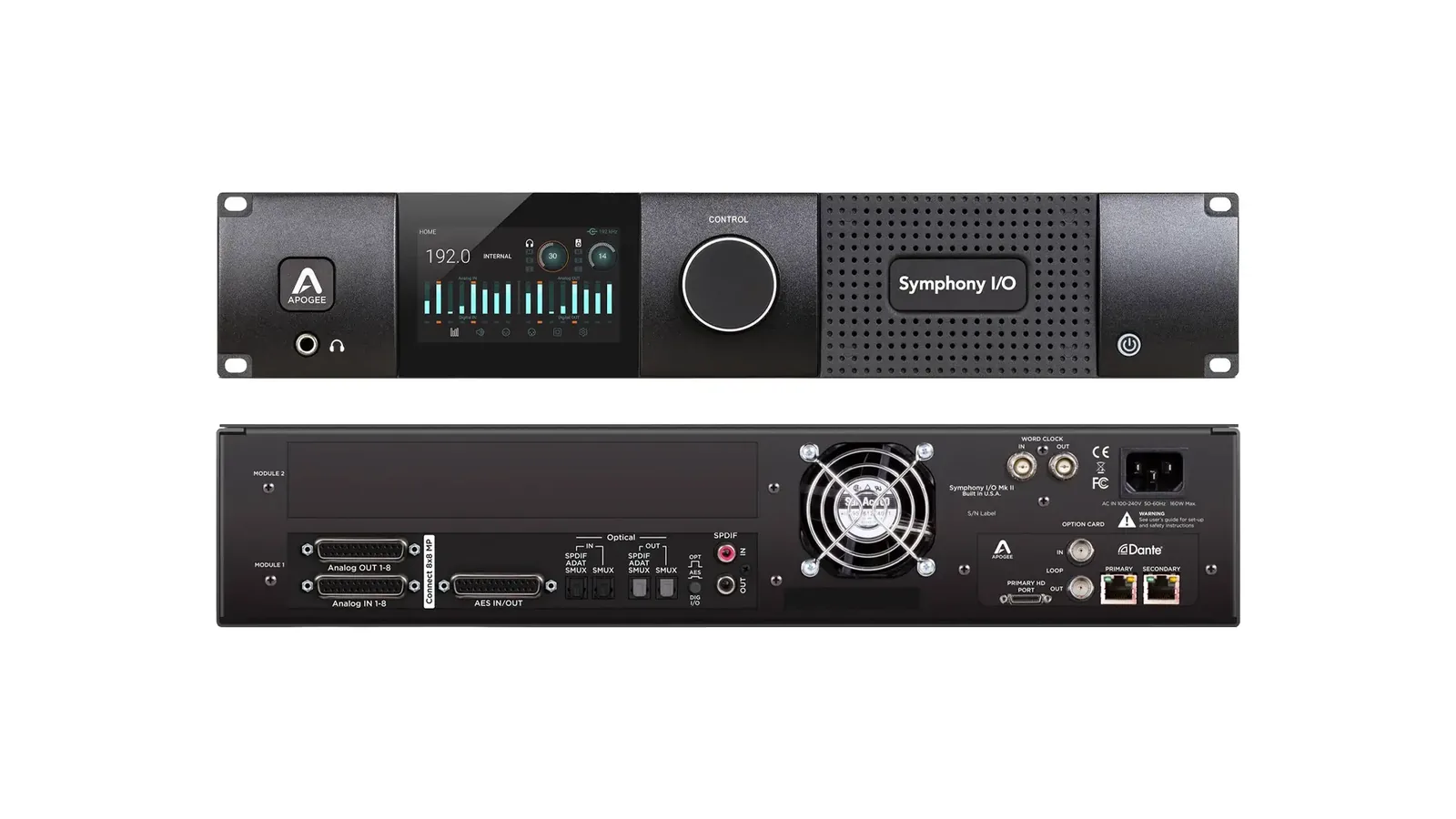
Eight channels of Apogee’s best AD conversion and eight of DA — the standard for mastering suites, mix rooms and recording studios. Transparent conversion at 192kHz on all channels. Modular design accepts optional mic preamp card. Thunderbolt 3, Pro Tools HD or Dante connectivity options.
Sixteen channels of AD conversion and sixteen of DA — the configuration for large recording sessions, orchestral tracking, live recording, Dolby Atmos mixing and high-channel post production. Expandable to 64 channels with dual daisy-chain. The standard specification for major film and television facilities worldwide.

The enhanced 16×16 configuration with premium AD/DA modules and Pro Tools HD connectivity option. Specified for the most demanding post production, mastering and film scoring work. Available with Thunderbolt 3, Pro Tools HD or Dante.
Symphony Desktop brings the same AD/DA conversion philosophy as the Symphony I/O Mk II into a compact, portable 10-in / 14-out Thunderbolt 3 interface. The choice for film composers, recording engineers and producers who need professional-grade conversion without rackmount bulk. Runs Apogee FX plug-ins in real time on its integrated hardware DSP.
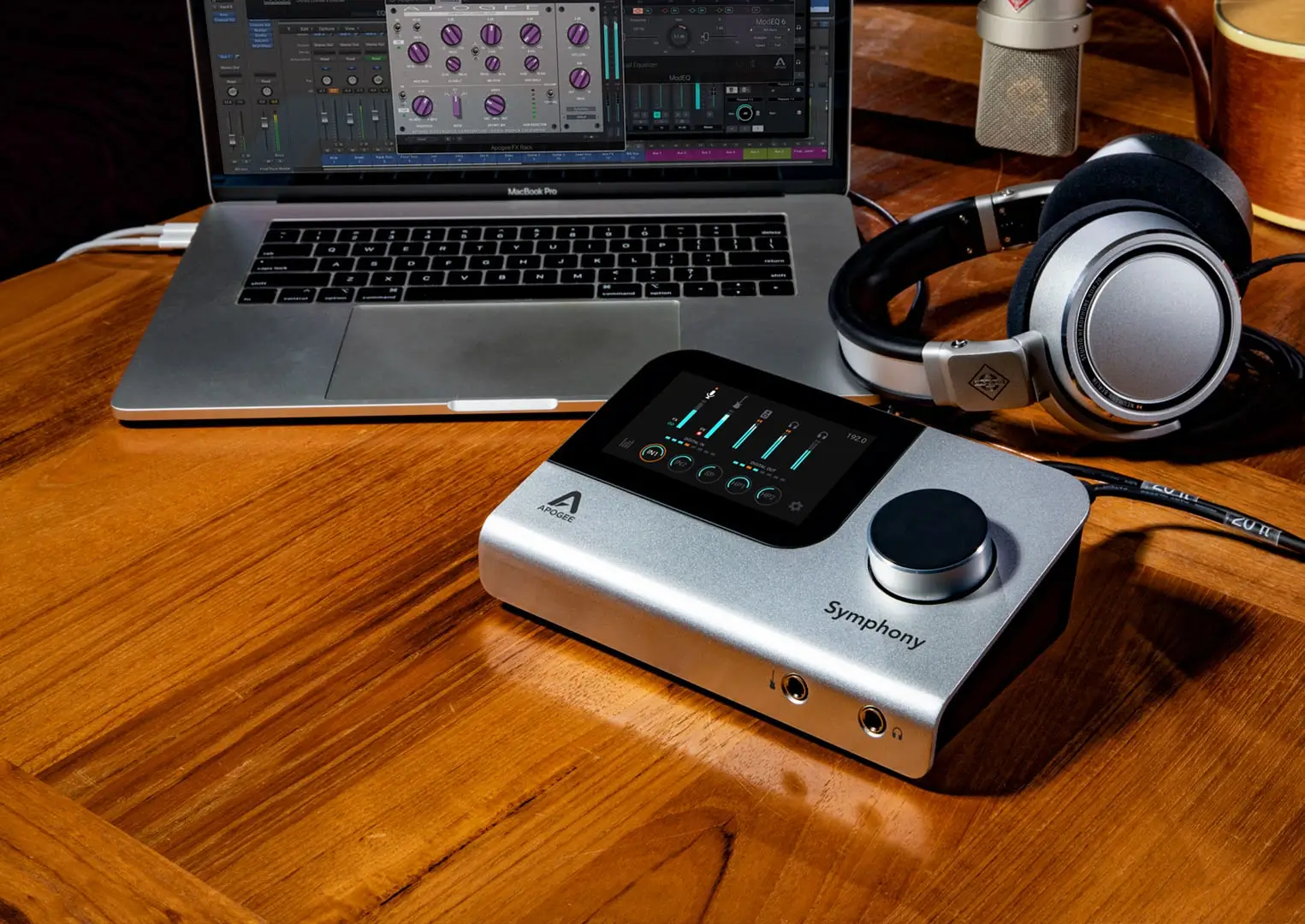
Two combo mic/line inputs with Apogee’s signature preamps plus a Hi-Z instrument input, 10×14 channels in total, and Thunderbolt 3 connectivity. Onboard DSP runs Apogee FX plug-ins on the hardware with near-zero latency. Perfect for composers scoring film, producers tracking sessions, and professional home studios demanding Symphony-class conversion in a portable footprint.
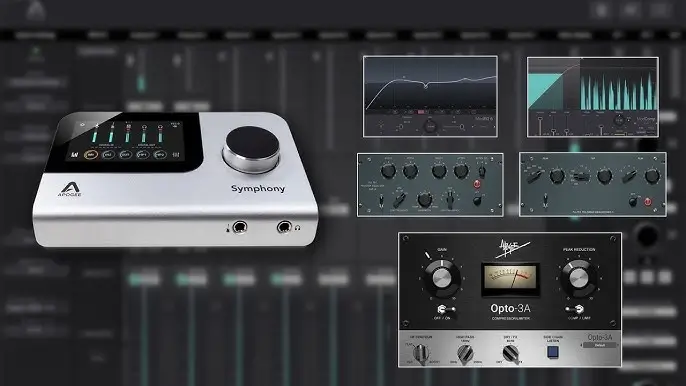
Built-in hardware DSP runs Apogee FX plug-ins without CPU load on your Mac — Pultec EQP-1A, Pultec MEQ-5, ModEQ 6, ModComp, Opto-3A and the Bob Clearmountain-tuned ECS Channel Strip. EQ, compress and saturate in real time on input or output. The integrated DSP eliminates the CPU overhead of traditional plugin chains while maintaining Apogee’s conversion quality. The future of hybrid analog-digital mixing.
Duet 3 is the musician’s interface — two inputs, Apogee conversion, USB-C bus power, works with Mac, iPad Pro and iPhone. Boom is the ultra-portable version for location recording and creators on the move. Both deliver Symphony-quality conversion in compact, tactile form.
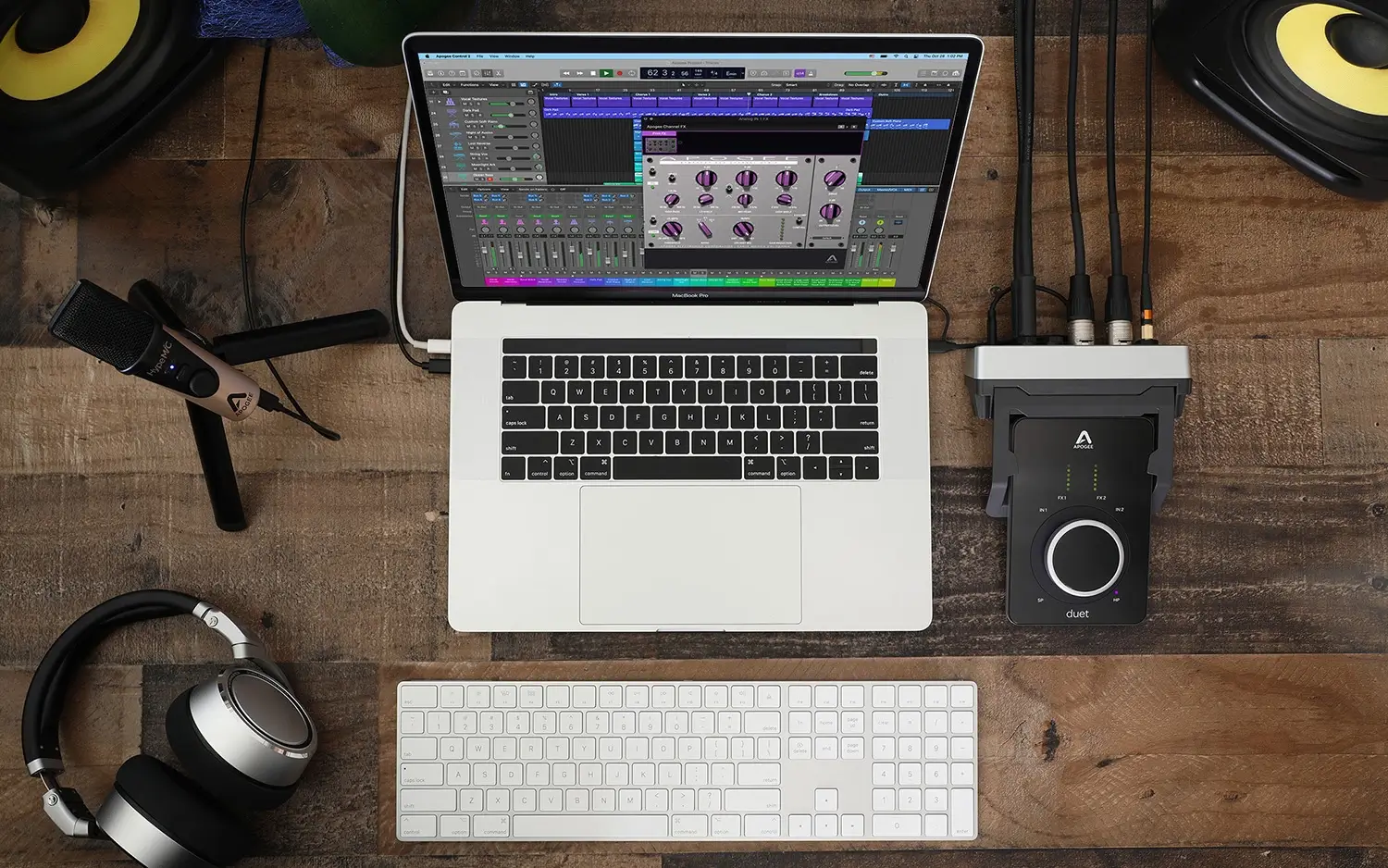
Two mic/line/instrument inputs, four outputs and Apogee’s professional-grade AD/DA conversion in a beautifully engineered aluminium chassis. The go-to interface for professional musicians and producers who work on Mac and iPad Pro since 2007. Bus-powered via USB-C. Works with Mac, iPad Pro and iPhone 15+. Apogee conversion in the smallest possible form.
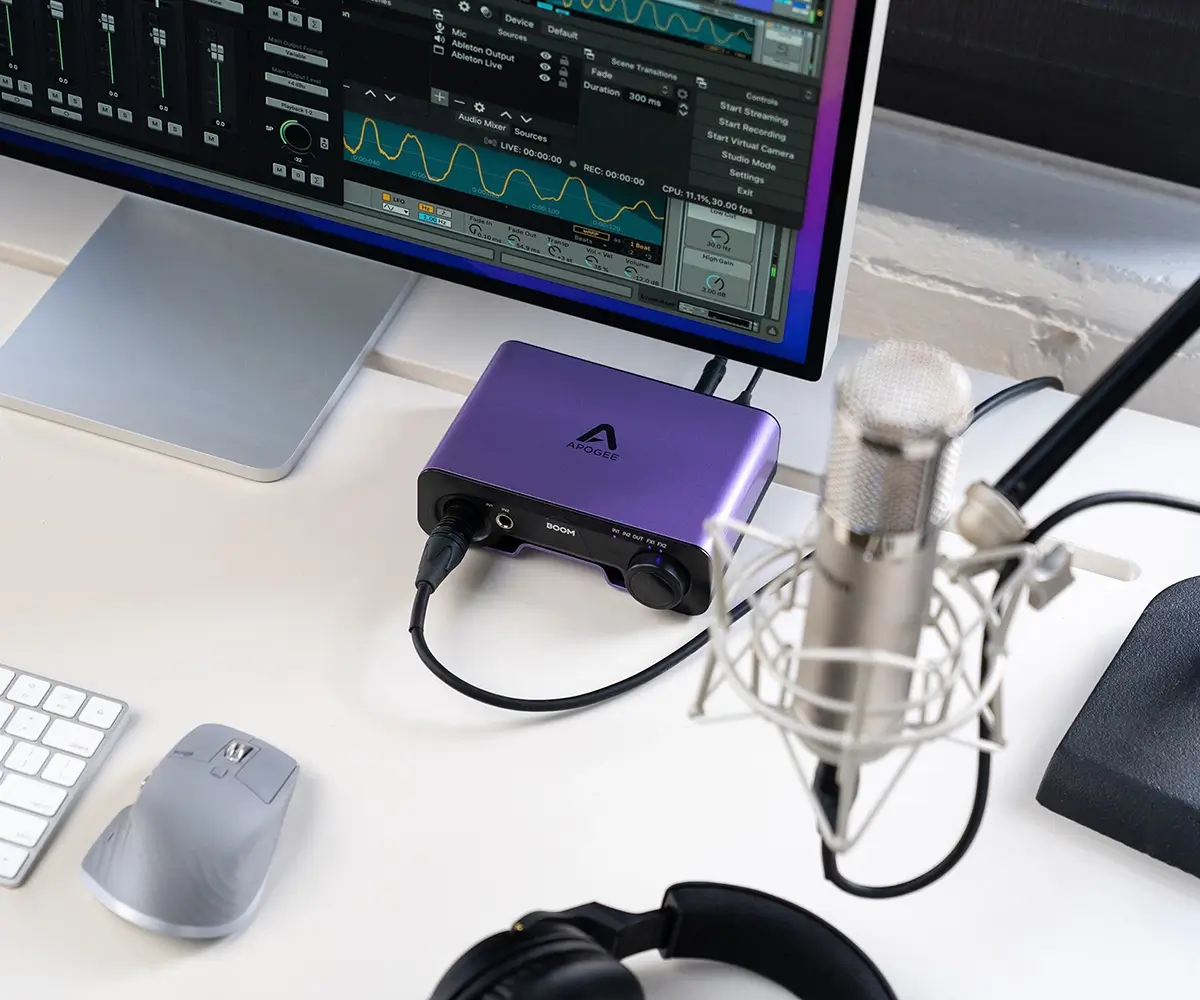
One combo mic/line/instrument input plus a Hi-Z instrument input, two TRS outputs and a headphone output over USB-C. The ultra-portable Apogee interface for field recording, location interviews, podcasting and creators who need professional audio in the smallest footprint. Bus-powered, works with Mac, iPad Pro and iPhone 15+. All the conversion quality, zero the bulk.
Symphony Studio brings Apogee’s flagship Symphony Mk II-grade conversion to a compact 1U rack, over USB-C — purpose-built for immersive mixing and playback up to 9.1.6. Onboard output DSP handles room correction, speaker delay and bass management, so the interface calibrates your room instead of leaving it to chance. Three configurations, one conversion standard.
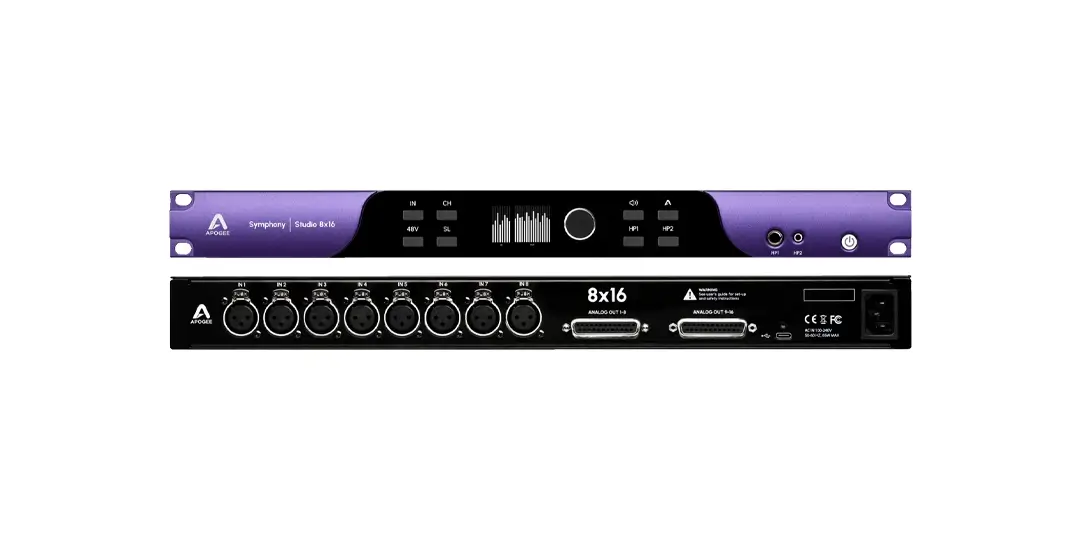
Two mic/line inputs and twelve line outputs — the direct route into 7.1.4 Dolby Atmos mixing for project and post studios. Full monitor control with dual independent headphone outputs and hardware DSP calibration on every output.
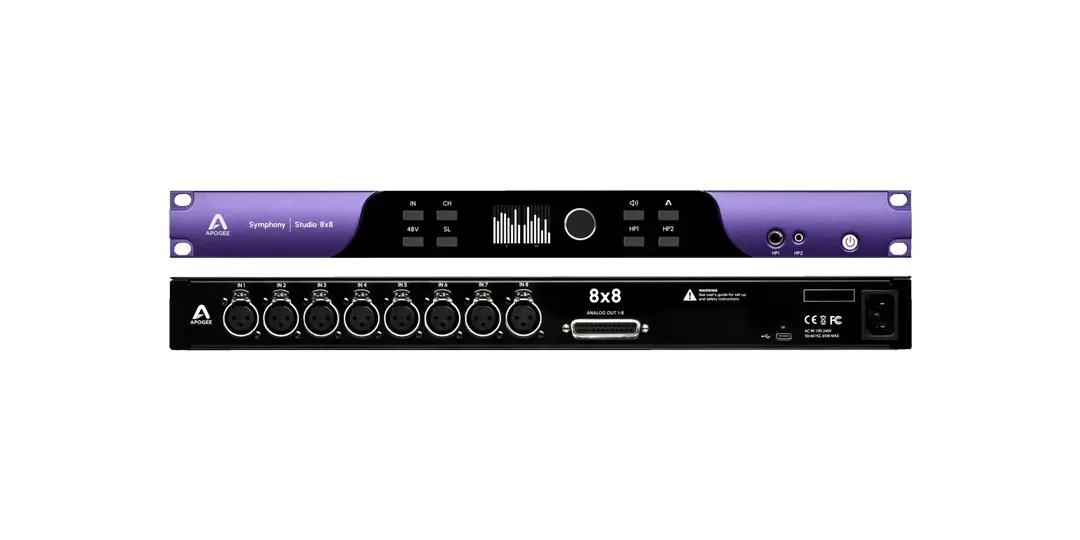
Eight mic/line inputs with 75dB of clean gain and eight line outputs — the tracking-room workhorse that also handles surround monitoring. Symphony-grade conversion on every channel, in a single rack unit.
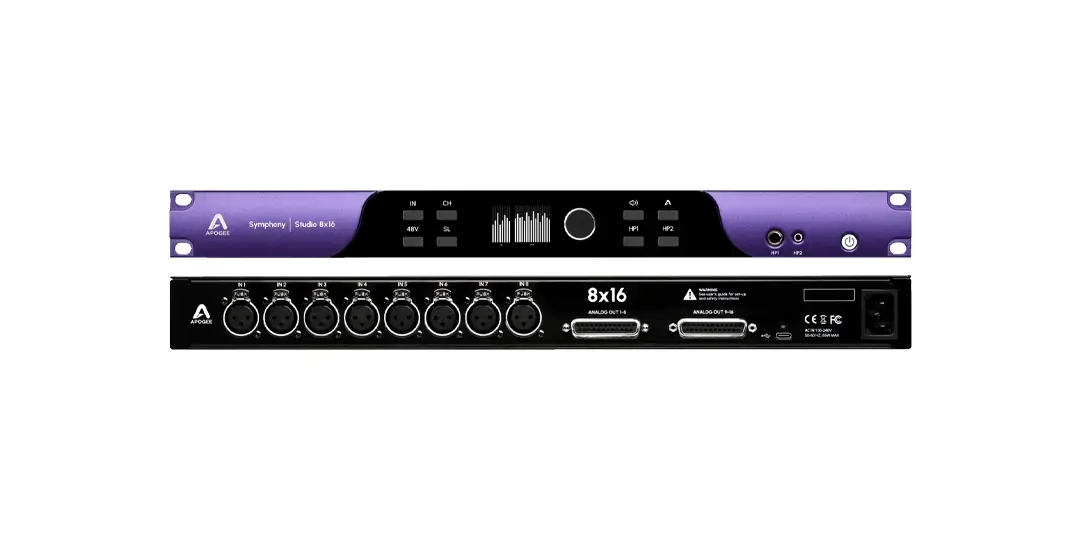
Eight mic/line inputs and sixteen line outputs for full 9.1.6 Dolby Atmos configurations — tracking, mixing and calibrated immersive playback from one box. The most complete Symphony Studio, for rooms that do it all.
JAM X is Apogee’s updated guitar interface with built-in analogue compression for better tone-shaping. JAM+ is the classic version. Both deliver Apogee conversion, hi-Z instrument input, zero-latency headphone monitoring and USB-C connectivity to Mac, iPad Pro and iPhone. Direct to your DAW with studio-quality signal.
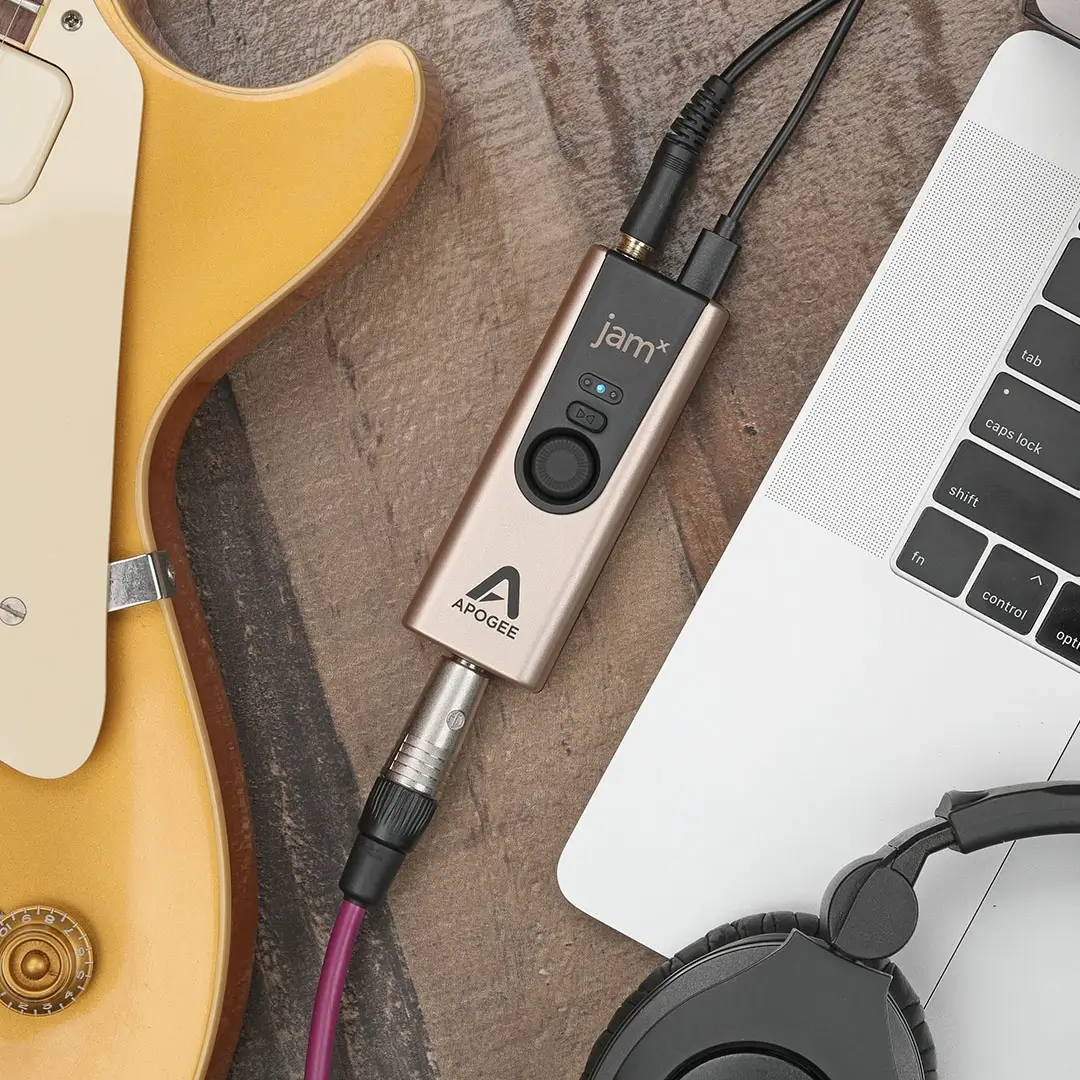
Guitar and bass DI with Apogee conversion, built-in analogue compressor for tone-shaping before the AD stage, hi-Z input for passive instruments, and USB-C connectivity to Mac, iPad Pro and iPhone 15+. The JAM X delivers professional-quality compressed guitar/bass tones without plug-ins — just plug in and record. Zero-latency headphone monitoring included.
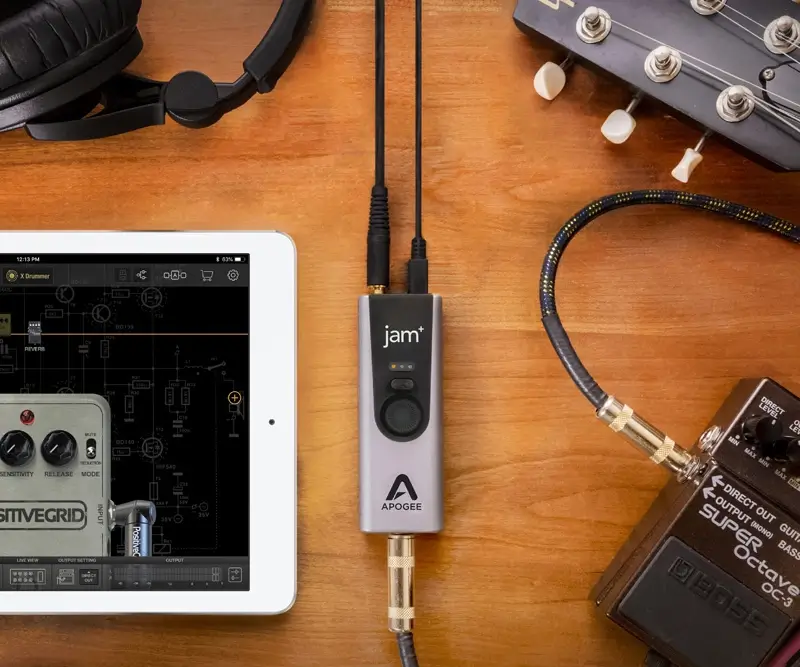
Guitar and bass DI with Apogee’s professional-grade conversion, hi-Z input and USB-C connectivity to Mac, iPad Pro and iPhone 15+. The classic JAM+ delivers straightforward Apogee conversion — no compression — giving you full control over your tone in the DAW. Headphone output for direct zero-latency monitoring. The choice for guitarists who prefer their own signal chain.
HypeMiC is the only USB microphone with a real built-in analogue compressor — delivering broadcast-quality compressed voice without a chain of gear. MiC+ is the professional cardioid for voiceover, interview and podcast recording. Both are USB-C, both carry Apogee conversion, and both run direct to your Mac or iPad — with Apogee’s free First Take app for multi-mic sessions.
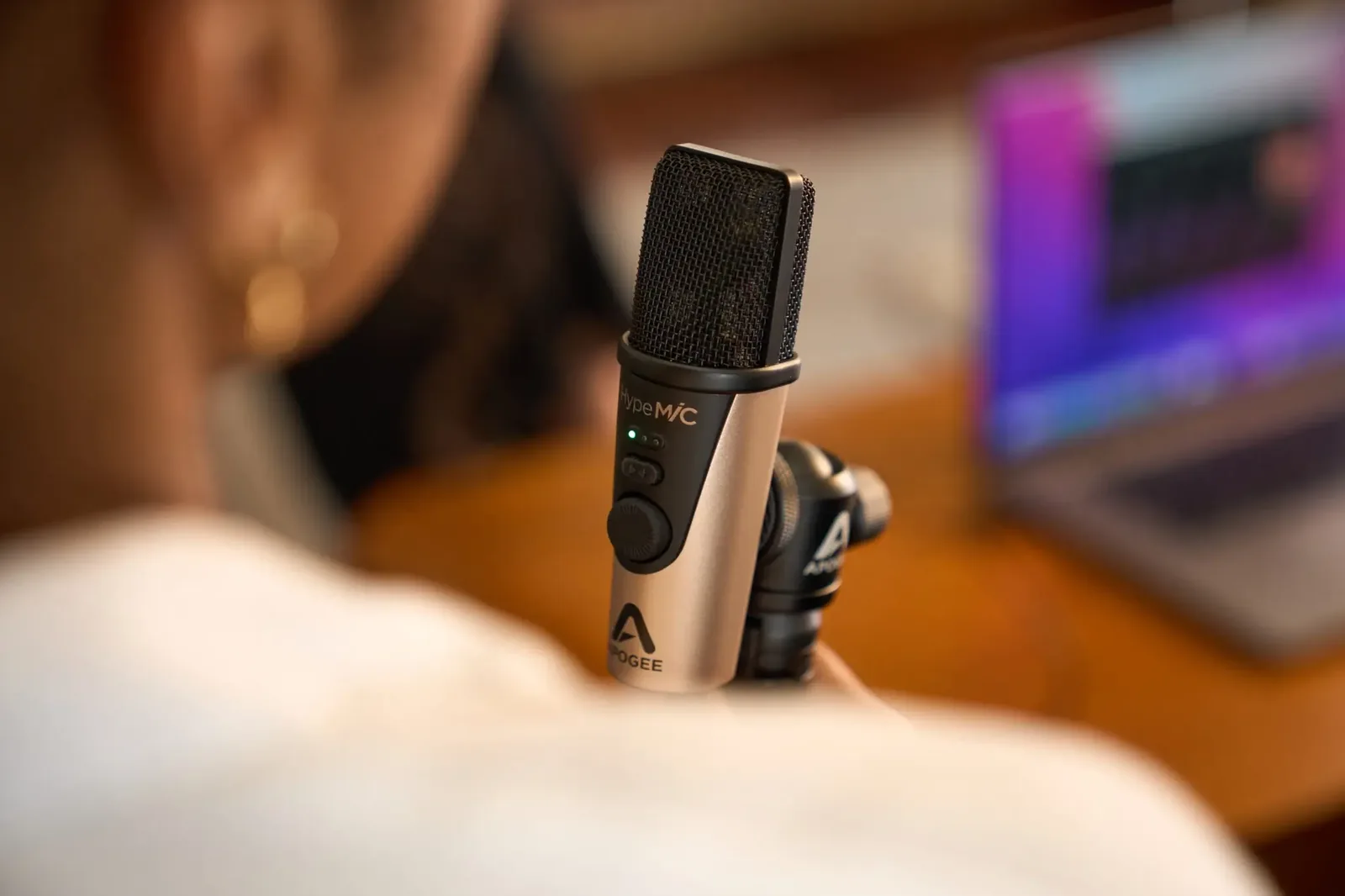
USB-C condenser microphone with a built-in analogue studio compressor — the only USB microphone with genuine analogue compression before the AD conversion stage. The HypeMiC delivers the presence, punch and controlled dynamics of a compressed vocal without any plug-in processing. Direct zero-latency monitoring through a headphone output. For podcasters, vocalists, beatmakers and content creators who want professional results from a single device.
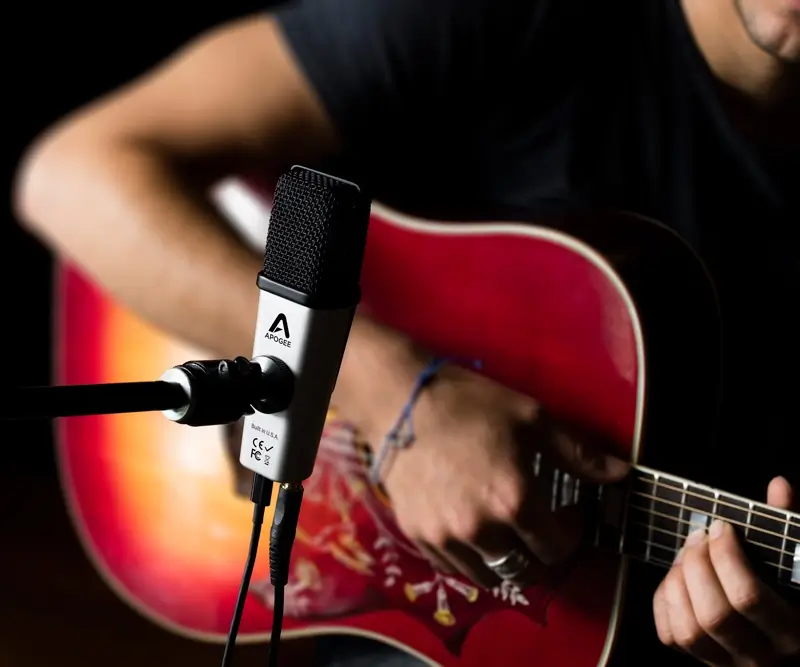
Cardioid condenser microphone with Apogee’s AD conversion via USB-C — connects directly to Mac, iPad Pro and iPhone 15+ without an adapter. The MiC+ is Apogee’s professional-grade USB microphone for podcasting, voiceover, interviews and home vocal recording. The same conversion quality as the Duet 3 in a single microphone form factor. Multiple gain settings via the onboard push-button allow optimisation for voice, instrument or room recording.
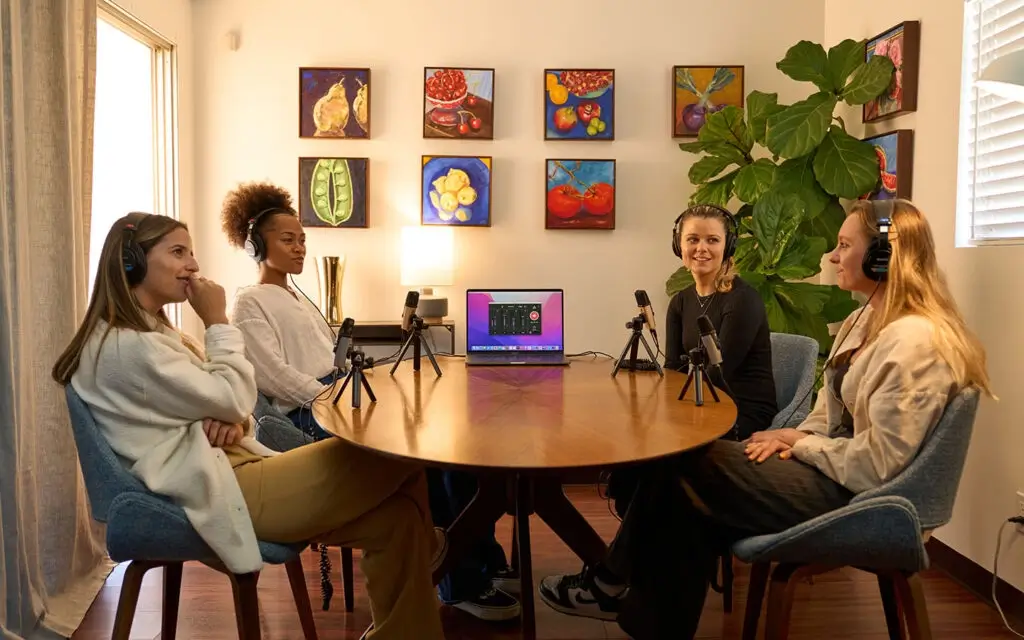
Apogee’s free recording application, not a microphone. Connect up to four Apogee USB mics to one computer or USB hub and record each to its own track at 24-bit/48kHz Broadcast Wave. Compatible with HypeMiC, MiC+ and ClipMiC digital 2. Built for podcasts, interviews and jam sessions — a session set up in seconds, with no audio engineering required.
The technologies that define Apogee’s forty-year pursuit of perfect conversion — and why mastering engineers and major studios choose Apogee over every other option.
Apogee’s proprietary converter designs are used as the reference standard by Grammy-winning mastering engineers. When the best engineers in the world need to know exactly what a recording sounds like, they play it through Apogee — because Apogee adds nothing and removes nothing from the signal.
Apogee has built for the Mac since Apogee’s earliest converters. Its USB-C interfaces are class-compliant and driver-free on Mac, working natively with Logic Pro, GarageBand and every Core Audio DAW. On iPad and iPhone with a USB-C port, Duet 3, Boom, JAM X, JAM+ and the USB-C microphones connect directly — no adapter.
Apogee Thunderbolt interfaces achieve near-zero latency at 96kHz — enabling real-time monitoring through plug-in chains without perceptible delay. The Symphony I/O Mk II can sustain 30 or more simultaneous channels over a single Thunderbolt cable with no dropout at any sample rate up to 192kHz.
The Apogee Control hardware remote connects to Symphony I/O Mk II and gives physical control over monitor volume, sample rate, headphone levels and routing. Combined with the Apogee Control 2 software, it delivers hardware-grade control from a single tactile knob and display.
Apogee’s proprietary Soft Limit circuit applies gentle analogue limiting before the AD stage — preventing digital clipping on unexpected transients without audible compression artefacts. The result is a recording that can be pushed hotter without the hard digital ceiling that clips other interfaces. A signature Apogee technology present in every product.
Every Apogee interface is machined from solid aluminium — the same material standard as professional monitoring hardware and high-end studio equipment. The Duet has kept essentially the same machined form factor across generations. Studios running original Apogee Rosetta units from 2002 are still in operation today.
From mastering suites to film scoring stages, from home studios to broadcast facilities — Apogee’s conversion is trusted wherever accuracy cannot be compromised.
Symphony I/O Mk II is the reference converter for Grammy-winning mastering engineers worldwide. Transparent, phase-accurate, the standard against which all other converters are measured.
Symphony Desktop and Symphony I/O Mk II are used by major film composers globally. Real-time plugin processing, low-latency monitoring, and mastering-grade conversion for orchestral sessions.
HypeMiC with its built-in compressor and MiC+ deliver broadcast-quality voice recording without external gear, and the free First Take app records up to four of them at once. Professional audio in the most compact form.
JAM X with built-in compression and JAM+ are the professional DI choice for guitarists and bassists recording directly to their DAW. Transparent conversion that preserves instrument dynamics.
Duet 3 and Boom bring professional Apogee conversion to the desktop and on the road. The interface of choice for producers and musicians who value conversion quality over channel count.
Music technology and audio engineering schools choose Apogee because students learn on professional interfaces they’ll use after graduation. Duet 3, JAM X and the USB-C microphones across the curriculum.
Three rooms, three Symphony systems — find yours.
Apogee conversion on a desk — from the two-channel classic to desktop Symphony sound.
The two-channel Apogee standard for writing and tracking at the desk.
Compact 2×2 interface with built-in DSP.
Symphony-grade conversion and DSP in desktop form.
Symphony Studio was built for immersive monitoring — one box per room size, 2×12 to 8×16.
2×12 for stereo-in/Atmos-out, 8×8 and 8×16 as channel counts grow.
Symphony Studio handles the monitor path for immersive layouts.
Deliver stereo and immersive from the same room.
Symphony I/O Mk II is the flagship converter platform for studios that live at the highest channel counts.
Symphony I/O Mk II in 8×8 or 16×16 configurations.
Special Edition raises the ceiling for flagship rooms.
The converter platform the facility is built around.
Joel is MediaCast’s specialist for Apogee Electronics, Universal Audio, IK Multimedia and MOTU. He’s specified Symphony systems for mastering suites, Duet rigs for film composers and HypeMiC setups for broadcast podcasters across the region.
Tell him the room and the work it has to deliver. He’ll match the interface to the job — Duet on a desk, Symphony Studio for Atmos, Symphony for the flagship chain — and you can hear the conversion at MCX before you decide.

Start wherever it feels easiest. Visit us, message us, call us or send the details through. We will guide you to the right person and the right next step.
Come in, explore the portfolio and spend time with the technology in Barsha Heights.
Professional technology, trusted brands and expert support, whenever you need it.
Tell us what you are working on. We will shape the route, with clear options and pricing.
Need a quick answer? Reach out for advice, availability checks or a helping hand.
Certified courses for users, operators, integrators and partners — at MCX or on your site.
For quotations, project discussions and anything that deserves a more detailed conversation.